


The 5 Industrial Revolutions and Why the Fifth Is Now


When I talk about Industry 5.0, people's first reaction is often: "But we haven't even properly implemented Industry 4.0 yet..."
And this is exactly where the misunderstanding lies.
Industrial revolutions do not end neatly one after the other, like the chapters in a book. They flow into each other, build on each other, and while one half of the world is still struggling with the previous level, the next wave has already begun. The question is not when we will reach the end of 4.0. The question is when we will decide: will we be part of defining 5.0, or will we be its victims?
Let's take a look at how we got to where we are today and why now.

Industry 1.0 — The Age of the Steam Engine (1760–1840)
It started in England and changed everything.
The steam engine is not just a power source, but a change in perspective. Instead of human and animal muscle power, first: mechanical drive. Textile factories, railways, metallurgy. Masses leave the countryside for city life, cities suddenly grow.
In this era, humans function as resources alongside machines. Work is dehumanized, but it is still physical and understandable. You can see what you are doing and for whom.
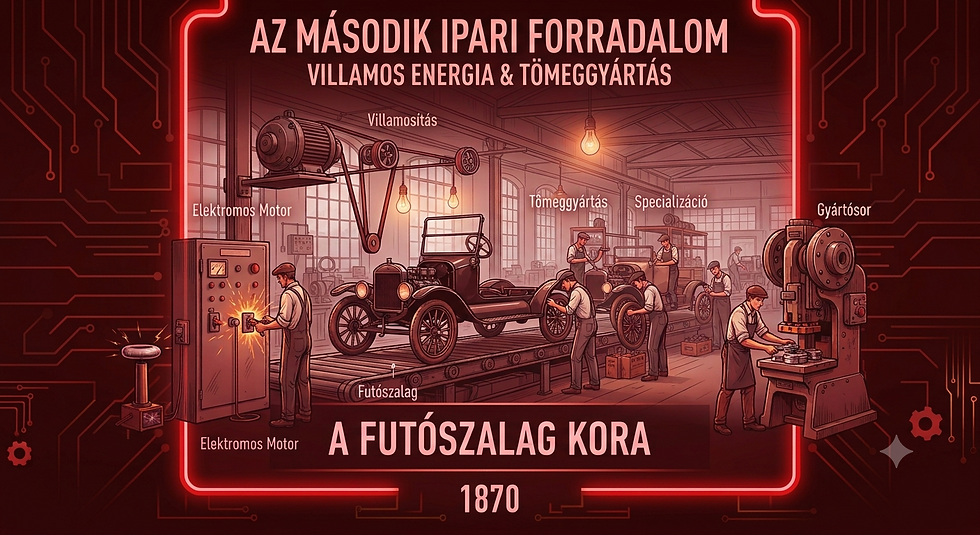
Industry 2.0 — Electricity and mass production (1870–1970)
Ford's assembly line will become a symbol of the 20th century.
Electricity, steel, and the chemical industry create the conditions for mass production. The worker is standardized: divided tasks, repetitive movements, measured performance. Efficiency becomes the only measurable value.
Humans are still an indispensable, but increasingly interchangeable, element in the system.

Industry 3.0 — Digitalization and Automation (1960–2010)
This is the moment when a person feels most strongly that they have become a competitor to the machine.
IT, robotics and global supply chains are reshaping production. White-collar work is also being digitized. The first major wave of job anxiety is surfacing here, and for good reason.
The world of 3.0 is efficient but rigid. The system optimizes and adapts.

Industry 4.0 — Smart Manufacturing (2010–present)
IoT (internet of things), artificial intelligence, big data, cyber-physical systems.
This is the era that most CEOs think, "We're already doing it."
In fact, most companies are in 3.5: the technology is often there, but the culture, the organization and the people have not followed. The majority of Industry 4.0 implementations have not failed due to technology . Due to people, culture, lack of change management. Due to the "IT will solve it" approach.
This diagnosis is much more than a criticism: it is the most important starting point for 5.0.

Industry 5.0 — Human-centered, sustainable, resilient (2021–)
The European Commission set the direction in 2021. It is not about a new technological leap, but a change in perspective.
Three pillars:
Human-centricity > technology serves people, not the other way around. The employee is not a resource, but a unique human value. 5.0 starts where 4.0 got stuck: on culture and people.
Sustainability > economic growth does not come at the expense of the environment. The circular economy, carbon footprint reduction and responsible resource use are not trendy, optional add-ons, but the foundation of the business model.
Resilience > the company is able to survive shocks. COVID, supply chain disruptions, energy crisis: recent years have shown that globally optimized systems are fragile. The 21st century company is flexible, adaptable and locally viable.
Why now?
There are two deadlines for 2030, which are mandatory for all EU companies:
The Fit for 55 climate package calls for a 55% reduction in emissions. The Digital Decade target requires 75% of EU companies to use AI and cloud-based solutions. Currently, this rate is 13.5%.
Anyone who doesn't start in 2026 will be left behind by 2030.
Our role
The CEE region (Hungary, Czech Republic, Poland, Slovakia, Austria) is in a unique situation. The industrial tradition is strong, but the culture of transition has not yet been established. This is precisely the moment when we can and must position ourselves.
The historical - political and national - international economic turning point coincides in 2026!
That is why we are founding the Central and Eastern Europe regional Industry 5.0 Alliance in November 2026, in Győr, within the framework of the SHIFT I. Industry 5.0 CEE Alliance Summit .
Because 5.0 is not the next technology project. It is a decision about what kind of industry and what kind of jobs we want after 2030.
Valéria Szabó is the founder of the Industry 5.0 CEE Alliance and the lead facilitator of the culTUNEration Movement. More information and tickets for the SHIFT I. CEE Alliance Summit can be found at: cultuneration.com/industry-5-0-cee-summit


Comments